How to Maximize Your Workouts Using Minimal Equipment
18 September 2026
You do not need a garage full of machines to get stronger, leaner, and more athletic. Some of the most effective training in the world happens with a pair of dumbbells, a resistance band, and a patch of floor. The catch is that minimal equipment demands more from you, not less. You have to understand how to create tension, how to progress without adding plates, and how to organize your training so your body keeps adapting instead of coasting.
This guide is about that craft. It covers what actually drives results, how to squeeze more out of the tools you already own, and the mistakes that quietly stall progress when your setup is simple.
Why Minimal Equipment Works Better Than Most People Expect
Muscle and strength respond to mechanical tension, metabolic stress, and muscle damage, in that order of importance. Mechanical tension is the big one. It means your muscles are producing high force while lengthening or shortening under load. You can create that with a barbell, or you can create it with a single leg squat performed slowly with a pause at the bottom. The muscle does not know what the equipment looks like. It only knows how hard it has to work.There is a second advantage that gets overlooked. Minimal equipment forces you to master movement quality. When you cannot hide behind a machine that locks your joints into a fixed path, your stabilizers, core, and coordination get trained whether you planned for it or not. A push up trains your shoulders, chest, and triceps, but it also trains your serratus anterior and your ability to keep your hips from sagging. That transfer shows up in real life and in sport.
The trade-off is real, though. Limited load makes some goals harder to reach. Maximal strength in the squat and deadlift, for example, is difficult to build with bodyweight alone because your legs are already strong enough to move your body. For that goal, you eventually need external resistance. So the honest answer is that minimal equipment works extremely well for general strength, muscle growth, fat loss, and athleticism, and it works less well for chasing a 500 pound deadlift. Knowing which camp you are in shapes everything else.
The Core Toolkit That Covers Almost Everything
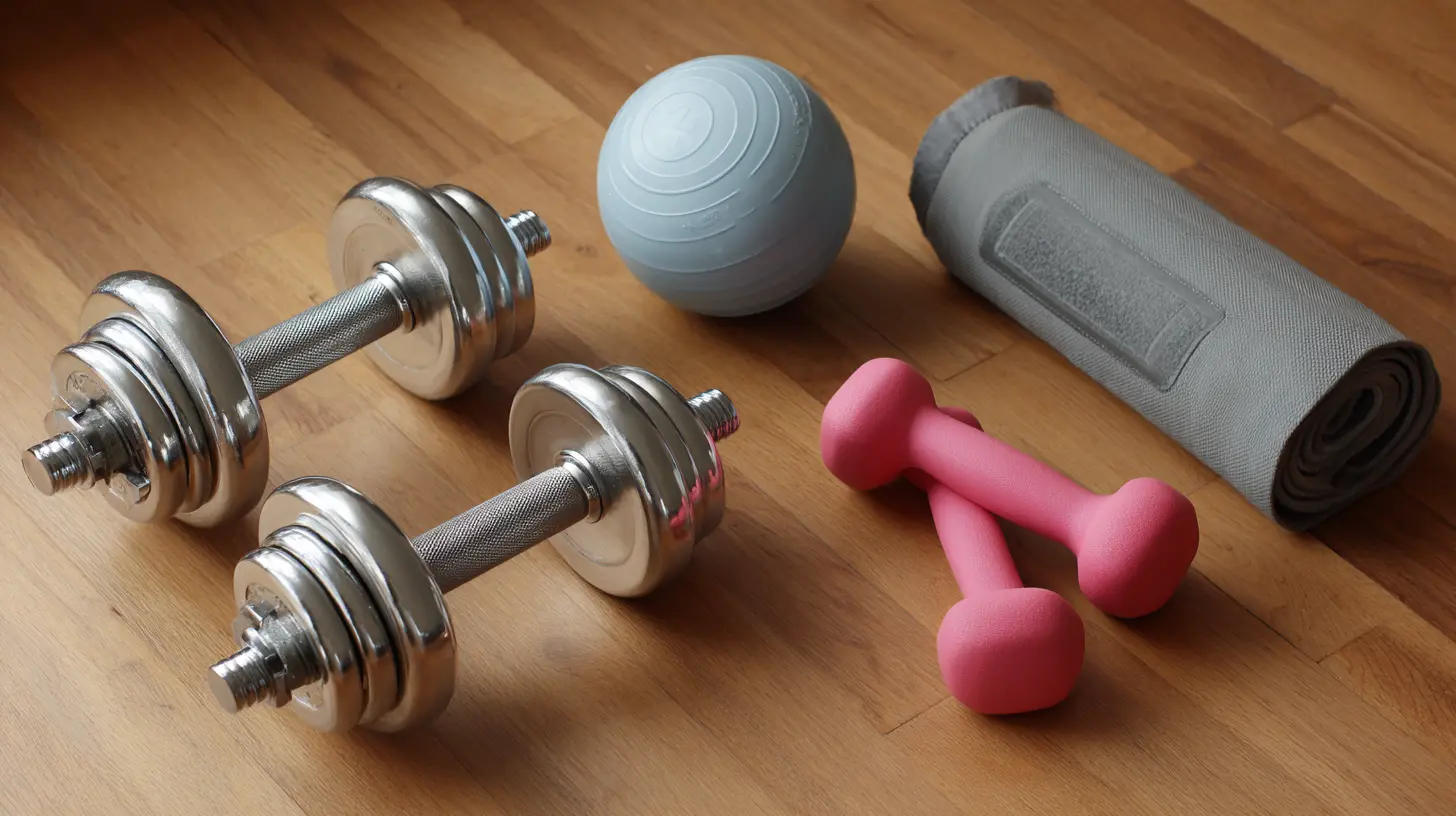
You can build a complete, year round program with a surprisingly short list. Here is what earns its place.A pair of adjustable dumbbells. This is the single most valuable purchase for a home setup. Fixed dumbbells are great until you need 15 different weights and run out of floor space. Adjustable ones let you progress from a 10 pound lateral raise to a 60 pound row without buying a rack.
One or two resistance bands, ideally with handles and a door anchor. Bands are not a downgrade. They are a different tool. Their resistance increases as you stretch them, which means the hardest part of the movement is at the end range. That makes them excellent for glute work, pull aparts, face pulls, and any movement where you want accommodating resistance.
A pull up bar. If you can install one, do it. Vertical pulling is the hardest movement pattern to replicate without equipment, and a bar solves it. A doorway version works fine for most people.
A suspension trainer or a sturdy towel and a door. Suspension trainers let you adjust difficulty by changing your body angle, which is a form of progression that costs nothing.
A jump rope or just open floor space. For conditioning and plyometrics, your body and gravity are enough.
That is it. Everything below assumes roughly this kit, and anything you are missing can be substituted with a small amount of creativity.
The Principle That Makes Light Loads Feel Heavy
If you only remember one idea from this article, remember this: intensity is not the same as load. Intensity is how close you are to failure. A set of 20 bodyweight squats taken to the point where you could not do one more rep is genuinely hard training. A set of 10 heavy squats stopped five reps short of failure is easier than it looks on paper.This is why minimal equipment can still build muscle. Research on hypertrophy consistently shows that sets taken close to failure produce similar growth whether the load is heavy or light, as long as effort is high. The practical translation is that you should be finishing most working sets with one to three reps left in the tank, and occasionally going to true failure on isolation work.
The trap is that light loads let you cheat effort. You can do 30 half rep curls and feel like you trained. You did not. You moved your arms. The fix is to make every rep honest and to use the progression tools below so that "close to failure" stays close to failure over months, not just weeks.
Six Ways to Progress Without Adding Weight
Progressive overload is the requirement for long term results. Most people think it only means adding weight. It does not. Here are six levers you can pull, and when each one makes sense.1. Add reps
The simplest lever. If you did 3 sets of 8 push ups last week, do 3 sets of 9 or 10 this week. This works well until you hit a rep range where the set becomes more about endurance than strength, usually somewhere past 20 to 25 reps for most movements.2. Slow the tempo
Slowing the lowering phase increases the time your muscle spends under tension and makes a light load much harder. A push up lowered over four seconds is a different exercise than a fast one. Use this when you are stuck at a rep number and cannot add load. Do not slow every phase of every rep forever, or your sessions become a grind. Two to four seconds on the lowering phase is plenty.3. Add pauses
Pausing at the hardest point of a movement removes the stretch reflex and forces your muscles to generate force from a dead stop. A two second pause at the bottom of a squat or the top of a pull up makes the movement significantly harder without any equipment change. This is one of the most underused tools in home training.4. Change the leverage or range
Elevating your feet turns a normal push up into a harder push up. Elevating your hands makes it easier. A one arm row with your hand on a bench is easier than a row from a dead hang position. You can fine tune difficulty by inches. This is the suspension trainer's whole trick, and you can apply it to almost anything.5. Reduce rest between sets
Cutting rest from 90 seconds to 45 seconds increases the metabolic demand and makes the same work feel harder. It is a legitimate progression for conditioning and muscle endurance. It is a poor choice if your goal is maximal strength, because fatigue will limit the force you can produce.6. Increase density or volume
Do the same work in less time, or add a set. Both increase total training stress. Add sets gradually, because volume is easy to overshoot and hard to recover from when you are training hard.Rotate these levers instead of relying on just one. If you only add reps, you will eventually hit a wall. If you only add tempo, your joints will complain. Variety in how you progress keeps adaptation going and keeps you interested.
Building a Balanced Program With Almost Nothing
Every program needs to cover a handful of movement patterns. Miss one and you create gaps that show up as nagging issues or stalled progress. The patterns are: a horizontal push, a horizontal pull, a vertical push, a vertical pull, a squat, a hinge, and some form of carry or core work.Here is how that maps onto minimal equipment.
Horizontal push: push ups of every variation. Decline, incline, close grip, archer, and single arm as you get stronger.
Horizontal pull: one arm dumbbell rows, band rows, or inverted rows under a table if you have a sturdy one.
Vertical push: overhead dumbbell press, pike push ups, or handstand push up progressions against a wall.
Vertical pull: pull ups, chin ups, or band assisted versions. If you have no bar, band lat pulldowns from a door anchor are the next best option.
Squat: goblet squats, split squats, Bulgarian split squats, and eventually single leg squats. The split squat family is where minimal equipment really shines, because single leg work is brutally effective with modest load.
Hinge: Romanian deadlifts with dumbbells, single leg deadlifts, and hip thrusts or glute bridges with a band or a dumbbell across your hips.
Carry and core: farmer carries with dumbbells, suitcase carries, planks, dead bugs, and hanging knee raises if you have a bar.
A simple weekly structure could be two full body sessions, one upper focused session, and one lower focused session, with a day of walking or easy movement in between. Three full body sessions also works well if your schedule is tight. What matters is that each pattern gets trained at least twice a week with enough effort to matter.
Sample Three Day Week You Can Actually Follow
This is a template, not a rulebook. Adjust reps and variations to your level.Day 1
- Goblet squat: 3 sets of 8 to 12
- One arm dumbbell row: 3 sets of 8 to 12 per side
- Push up variation: 3 sets of 8 to 15
- Band pull apart: 3 sets of 15 to 20
- Plank: 3 sets of 30 to 45 seconds
Day 2
- Romanian deadlift: 3 sets of 8 to 12
- Overhead press: 3 sets of 8 to 12
- Pull up or band pulldown: 3 sets of 5 to 12
- Split squat: 3 sets of 8 to 12 per leg
- Suitcase carry: 3 sets of 30 to 40 steps per side
Day 3
- Bulgarian split squat: 3 sets of 8 to 12 per leg
- Incline or decline push up: 3 sets of 8 to 15
- Single leg deadlift: 3 sets of 8 to 10 per leg
- Band face pull: 3 sets of 15 to 20
- Dead bug: 3 sets of 10 per side
Rest 60 to 90 seconds between sets for most movements. Take longer on the hardest compound lifts. Add reps or difficulty each week until you cannot, then change a variable.
Common Mistakes That Waste Your Effort
Training too easy and calling it consistency. Showing up matters, but showing up and moving without effort does not build much. Track your sets and reps. If the numbers have not moved in a month, something needs to change.Skipping the pulling work. Push ups are popular because they are accessible. Rows and pull ups are not, so people skip them. That imbalance eventually shows up as shoulder pain and posture problems. Pull at least as much as you push.
Chasing soreness as proof. Soreness is a poor progress marker. It depends on novelty more than effectiveness. A new exercise makes you sore. A productive program makes you stronger over months.
Ignoring the eccentric. The lowering phase is where a lot of muscle building happens and where you have the most control over difficulty. Do not drop into the bottom of a squat or let gravity do the work on a push up.
Doing endless random workouts. Variety feels good, but progress comes from repeating movements and beating your previous numbers. Keep a core set of lifts for 6 to 8 weeks, then rotate.
Neglecting recovery. Minimal equipment training can be done more frequently, but your muscles still need sleep, protein, and easy days. More is not better once recovery is the bottleneck.
Making Cardio and Conditioning Count
You do not need a treadmill or a bike to improve your conditioning. You need to raise your heart rate and sustain it, or push it hard in intervals. Jump rope intervals, stair sprints, shadow boxing, burpees, and fast walking on hills all work.The best choice depends on your joints and your goals. Jump rope and burpees are efficient but high impact. If your knees complain, rowing motions with a band, shadow boxing, or brisk incline walking are gentler. For fat loss, the total energy expenditure over the week matters more than the specific method. A 20 minute hard interval session three times a week plus daily walking covers most people's needs.
One caution: do not stack hard conditioning on top of hard strength work every day. Pick two or three hard days and keep the rest easy. Constant moderate to high intensity without recovery is a recipe for stalled progress and burnout.
When Minimal Equipment Is the Wrong Choice
There are situations where you should seek out more load or a different environment.If your primary goal is maximal strength in a specific lift, you need heavy resistance. Bodyweight and bands cannot fully replace a loaded barbell for that purpose. If you are a competitive powerlifter or weightlifter, a gym is not optional.
If you have a history of certain injuries, some bodyweight positions may be problematic. Deep single leg work and overhead pressing can aggravate existing issues for some people. That does not mean avoid them forever, but it does mean getting guidance and choosing variations that fit your body.
If you find that you simply will not train hard without the structure and atmosphere of a gym, then the gym is the right tool for you. Adherence beats theory every time. The best program is the one you actually do.
Practical Tips That Make a Real Difference
Warm up with the movements you are about to train, not with a generic routine. A few easy reps of the exact pattern primes your nervous system and lets you use better form on your working sets.Film yourself occasionally. Without mirrors and machines, it is easy to develop compensations you cannot feel. A 30 second video of a squat or push up reveals more than months of guessing.
Use a rep target range rather than a fixed number. Aiming for 8 to 12 reps and stopping when form breaks is more honest than forcing 12 sloppy reps.
Keep a simple log. A notebook or a notes app. Write down the exercise, the weight or variation, and the reps. Progress becomes obvious when you can see it, and it is the single easiest way to avoid spinning your wheels.
Take deload weeks. Every 6 to 10 weeks, cut your volume roughly in half for a week. You will come back stronger. Home training makes it tempting to go hard constantly because sessions feel short, and that is exactly how people burn out.
Putting It All Together
Maximizing minimal equipment comes down to three things. Train close to failure so light loads still challenge your muscles. Progress deliberately using tempo, pauses, leverage, and volume instead of only weight. Cover every movement pattern so your body stays balanced and resilient.The equipment is not the limiting factor for most people. Effort, structure, and patience are. A pair of adjustable dumbbells, a band, and a pull up bar can carry you through years of solid training if you use them with intent. Start where you are, track what you do, and make small increases over time. That is the whole game.
all images in this post were generated using AI tools
Category:
Exercise RoutinesAuthor:

Angelo McGillivray